


.png)

Compliance prep has a way of quietly eating the hours. The recs, the workpapers, the journals, the back and forward of review. It is the work that pulls senior people off client conversations and stretches a team thin at year end.
For a lot of us, the year just gone made that harder than usual. The Xero outages when we needed the platform most, the lodgement crunch, and the constant chasing of clients for their information. My heart goes out to everyone who felt it.
A new financial year is the right moment to think about this. You have had the year end just gone to reflect on what worked and what did not, and you have the months ahead to set the next one up. In our recent webinar, A full compliance job in under 90 minutes, I walked a real job through Abby from start to finish. This blog shares the main points, and the promise in the title is the one to hold onto: a full job, done in-house, in under 90 minutes.
Where the hours really go
When people say compliance takes too long, they usually picture the review. In practice, the drain sits earlier, in the setup and preparation.
A single job can have four to six apps open just to get it ready. Information gets chased, workpapers get built, journals get keyed, and the file goes back and forward before a partner can look at it. Senior staff end up lining jobs up instead of reviewing them, and the same steps repeat for every client, every year.
I am a chartered accountant with two practices of my own, and this is the part that had stopped adding up for me. The preparation is mechanical and it repeats, so it is exactly the kind of work that should be handled for you. It should not be that hard. That is the whole reason Abby exists.
A full job, in four steps
A compliance job is really four steps: gather, calculate, review and approve.
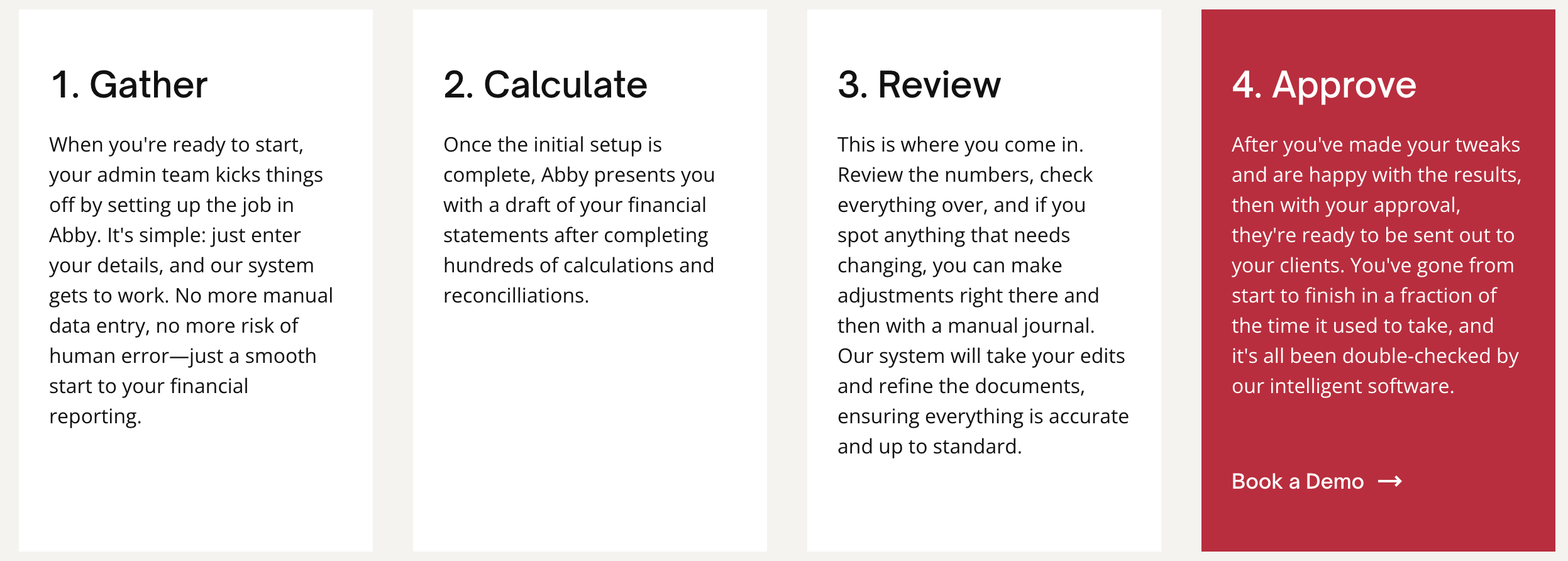
In the gather step, your preparer or admin sets the job up. Abby connects to Xero and XPM, and brings in the tax data from the ATO in Australia and the IRD in New Zealand, so it sits on every workpaper. You load the source documents too, the bank statements and loan statements, and Abby reads them. Mapping is a first-year job for each client, so once it is done, every year after is quicker.
Then Abby runs. In the calculate step, she prepares 40+ workpapers in about 30 seconds, with more than 1,000 calculations behind them, populated and pre-calculated. The journals come through drafted off the back of your source documents, ready for the reviewer. There is no data entry, and the same calculations run the same way every time, which is where the consistency comes from.
In the review step, your accountant works through what Abby has surfaced. She flags the variances and inconsistencies, with suggestions on where to look, and there is guidance on every workpaper, so newer team members can work through a job with confidence. In the approve step, your partner signs off, with the current year against last year and the reviewer's work in one place.
The heavy lifting is done in seconds, so a job that used to take a day can be through to review-ready in under 90 minutes, in-house.
What stays with the accountant
Abby does the preparation. The judgement stays with your team.
She surfaces the variances and offers suggestions, and your accountant decides what they mean. Some things stay with you on purpose. Investigating variances takes an accountant's judgement, individual tax returns stay in your hands, and financial statements are finalised in Xero. That line matters to me. The point is to hand the mechanical work to Abby and keep your people on the work that actually needs them.
What my practice looks like now
My team have been using Abby for 18 months. They spend their time on review and advisory now, not compilation. Capacity has come back week to week, the pressure points around year end have eased, and the conversations with clients have got closer because there is room for them.
None of that is theory. It is what a working practice looks like once the preparation is handled and the people are freed up for judgement. It is also the honest answer to the question I hear most, which is whether this really works in a busy firm or only in a demo. I run my own firm on it.
Final thoughts
A new financial year is the right moment to change how compliance gets done. You have seen where the hours go, and you have the year ahead to make the next one run differently. The old reason for accepting a slow, scattered process, that there was no better way, is the part that has changed.
You do not need to change anything today. The clearest way to judge it is to see a real job run, start to finish, and then run one of your own. If you would like to see what that looks like in your practice, book a demo and we will run a job together.

